
The 4th Amendment . . . Amended

I’ve always had a favorite constitutional amendment. Does that make me a con law geek? Probably. Still . . .
Don’t get me wrong, I love me some Fifth Amendment: the right against self-incrimination (police can’t beat a confession out of us); our protection against the government depriving us of life, liberty, or property without due process of law (we can’t be kidnapped by the government, stuffed on a plane and sent to prison in far-off lands without an opportunity to go to court, challenge the government’s conduct and have a judge decide what the government can/can’t do to us); the prohibition against a prosecutor charging us with a felony crime unless a grand jury – sitting as the conscience of the community – authorizes it.
I also love me some Sixth Amendment: the right to a public trial (no secret star chambers); the right to a jury trial (serving as a check on prosecutorial power because only members of our own community can declare us guilty of a crime); and the right to counsel (so we have someone in our corner when the entire government is against us).
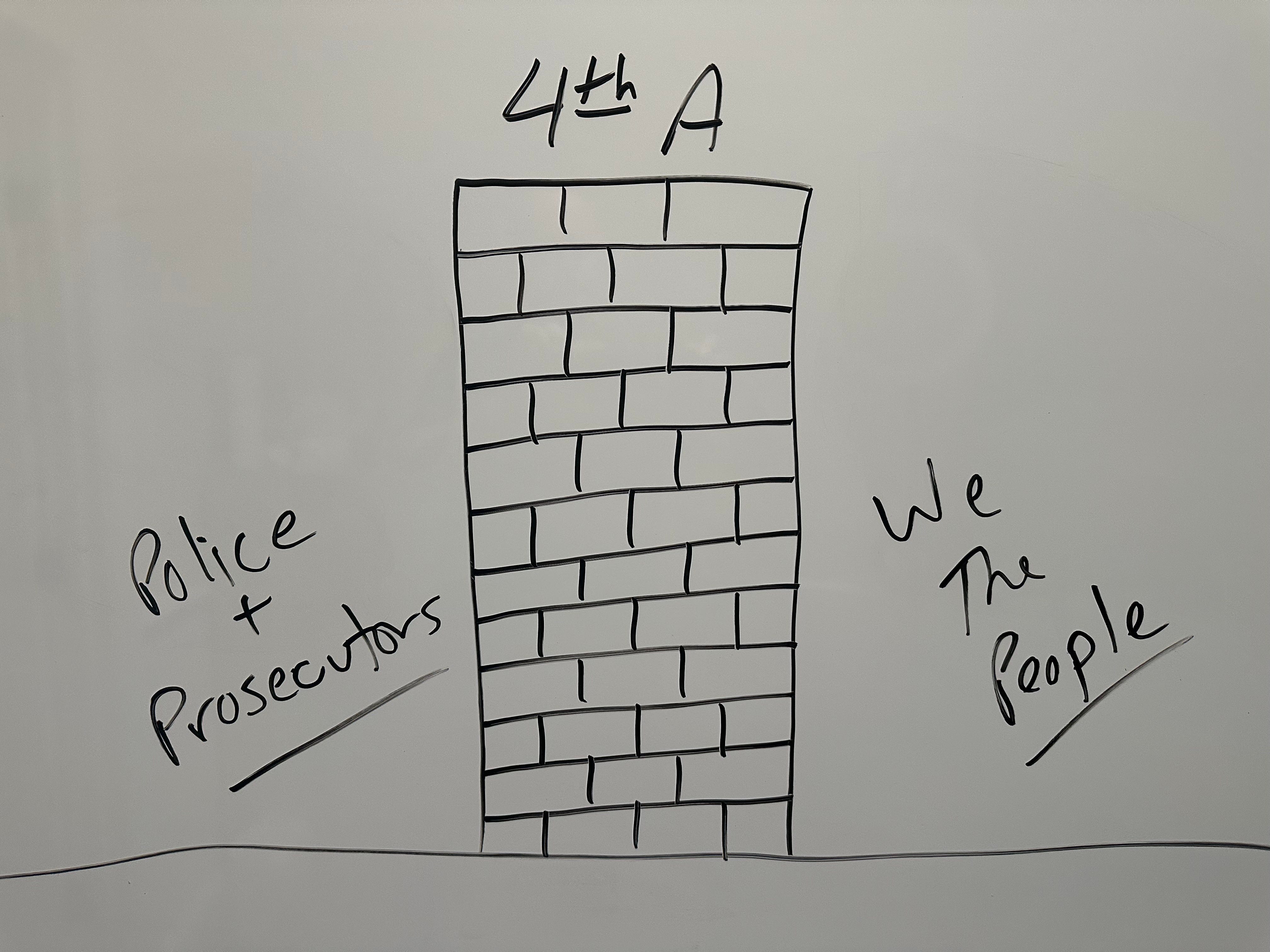
But the Fourth Amendment is my favorite. As I always told my George Washington University criminal justice students on the first day of each new semester: the Fourth Amendment stands as a wall between the government and the people. The police and the prosecutors are on one side of that wall, and we are on the other. I would actually draw a picture of a brick wall on the blackboard (ok, white board, see below). Because I’m a lousy drawer, this was the only picture I attempted to draw for my students all semester.
The government cannot scale or penetrate or circumvent that brick wall unless police and prosecutors do it right. Which brings us the protections the Fourth Amendment guarantees us all. That’s right . . . ALL! It protects American citizens, foreign visitors to our country, and undocumented immigrants alike:
“The right of the people to be secure in their persons, houses, papers and effects, against unreasonable searches and seizures, shall not be violated . . .”
Translated from legalese to English: the police can’t enter our homes, can’t take our stuff, and can’t stop, handcuff, or arrest us – all example of “seizures” - unreasonably. Countless court opinions have emphasized that “reasonableness is the touchstone of the Fourth Amendment.”
In 1967, the Supreme Court famously said, “the Fourth Amendment protects people, not places.” And the Court repeatedly has held that, just as the amendment itself says, all “people” – not just American citizens - enjoy the protections of the Fourth Amendment.
That is until, on September 8, 2025, when six Supreme Court justices “amended” the Fourth Amendment. Before turning to how the Supreme Court just decided Hispanics are unworthy of full Fourth Amendment protections, let me say that this should come as no surprise, as the Supreme Court as presently constituted has bastardized the Constitution before.
For Example: the Constitution expressly requires the president to “take care that the laws be faithfully executed.” This is pretty much the exact opposite of the Supreme Court announcing that a president can violate our nation’s laws and victimize the American people with complete immunity from criminal prosecution. As one of our nation’s preeminent constitutional scholars, Yale law professor Akhil Reed Amar, wrote: the Supreme Court “declared the Constitution itself unconstitutional.”
And here they go again. After hearing evidence about how ICE agents were conducting massive, roving immigrant sweeps, indiscriminately catching in their figurative nets US citizens, documented immigrants, and undocumented immigrants alike, U.S. District Judge Maame Frimpong concluded that there was a “mountain of evidence,” that ICE’s methods were violating the Constitution. The judge issued an injunction trying to prevent ICE from engaging in deportation operations that were violating the constitutional rights of many.
The 9th Circuit Court of Appeals affirmed Judge Frimpong’s decision and left the injunction in place.
Enter the Supreme Court. Without a majority opinion giving the lower court judges the courtesy of an explanation of where they went “wrong” in their findings of fact and conclusions of law, the Supreme Court reversed the judgment of the lower courts.
This absence of a majority opinion explaining why all of the lower court judges were wrong, leaves lower courts adrift. They hold hearings, issue informed and supportable findings and apply the law to fashion remedies to address governmental lawlessness. The judges craft lengthy legal opinions evincing meticulous reasoning analyzing and applying all available precedent.
Then, without a majority opinion, the Supreme Court summarily tells the lower court judges, in substance – ‘you’re all wrong. We won’t tell you how you’re wrong, why your wrong, or how you can retool and make things right. Just accept our conclusion without explanation that . . . you are wrong.’ This is corrosive to a well-functioning judiciary.
Supreme Court Justice Sonia Sotomayor hit the nail right on the head in her dissent, which justices Ketanji Brown Jackson and Elana Kagan joined. Justice Sotomayor wrote the following: “We should not have to live in a country where the Government can seize anyone who looks Latino, speaks Spanish, and appears to work a low wage job. Rather than stand idly by while our constitutional freedoms are lost, I dissent.”
In a very real sense, the Supreme Court just amended the Fourth Amendment. Stating the obvious, the Supreme Court cannot rewrite the Constitution. But here we are.
Here is the new version of the Fourth Amendment’s protections:
“The right of the people to be secure in their persons, houses, papers, and effects, against unreasonable searches and seizures shall not be violated, unless you look a certain way, you speak a certain way, and you are in vicinity of day laborers.”
Welcome to the age of Supreme Court-sanctioned racial profiling. Might a return to the days of “separate but equal” be next?
This is scarier than people maybe think. I'm not an American - I live in the UK, but not so many years ago, in 1930s Germany, they made the same sort of exceptions for Jewish people and those they maybe thought "looked Jewish". Your Supreme Court judges have opened up a real can of racist worms. Hispanic-looking today. Tomorrow?
It is really scary and heartbreaking to watch our constitution slowly being crumpled and trampled. Thankful for people like you that bring these issues to the forefront!